Home / Cat breeds / Ragdoll
Ragdoll breed guide
CFA says Ann Baker developed the Ragdoll in the 1960s in Riverside, California from a chosen group of domestic longhairs.
Vivid blue eyes and colorpoint coats helped make it one of the world's most popular breeds.
- Coat length
- Longhair
- CFA personality
- Docile, placid and affectionate
- Time to full size
- Four years
- Mature male weight
- 20 pounds or more
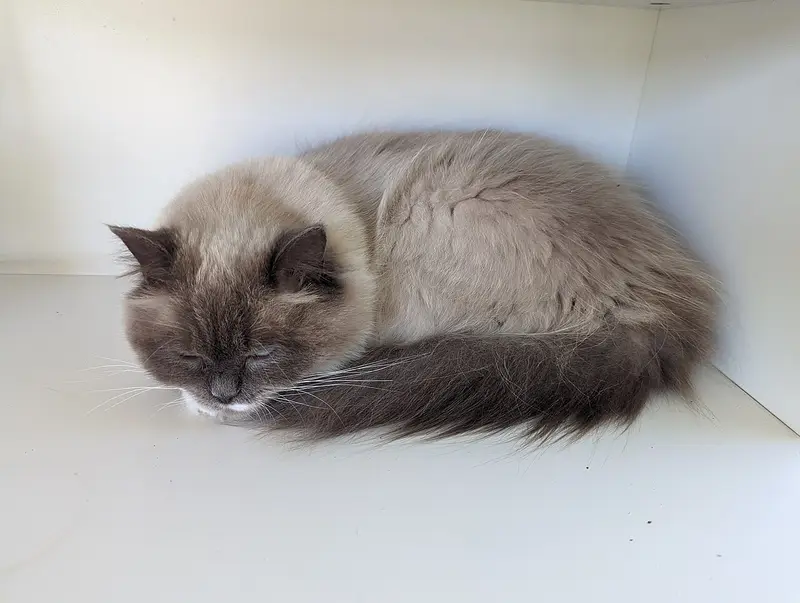
Ragdoll temperament
Loving without being demanding, gentle, calm and sociable, Ragdolls are excellent with children and get along well with other animals. Their trusting nature means extra care when introducing them to existing cats or dogs that may be less gentle.
Owners call them kittens that never quite grow up.
Ragdoll personality
Playful and very trainable, Ragdolls can learn to fetch and come when called. They greet you at the door, stay close and often sleep with their owners and some owners say the cats are attuned to their emotional needs.
They adapt easily to most environments and do not need a lot of living space. Not talkative, they may offer a soft mew now and then.
Ragdoll care
Grooming time is minimal: a steel comb once or twice a week removes loose hair and tangles. Shedding usually follows the seasons and is reduced because the coat lacks a thick insulating undercoat, which also reduces matting.
Ragdoll health
Hypertrophic cardiomyopathy has been found in the breed and breeders now routinely test for it and work to remove carriers. A 2007 study in Genomics identified the Ragdoll mutation as a change in the MYBPC3 gene that swaps a conserved arginine for tryptophan.
Known for their love of food, Ragdolls may be at risk of obesity, so CFA advises monitoring portions.
Ragdoll history
Josephine, a white domestic longhair carrying the colorpoint gene, was the foundation cat and Baker said her offspring had endearing temperament traits. Baker claimed Josephine was so placid that she went limp when held, which gave the breed its name, though CFA says that trait is not typical of most Ragdolls today.
CFA accepted the breed for registration in 1993 and advanced it to championship in 2000.
More cat breed guides
Sources
Photos via Wikimedia Commons: Ragdoll by Elli, CC0
.jpg)